Carbon-Financed Governance Reform to Unlock the World’s Largest Geothermal Reserve in Indonesia
July 6, 2026
The Price of Plastic: A Plastic Recovery Certificate Solution for Indonesia’s Circular Economy
July 8, 2026
Sustainable Food Innovation: Local Protein Substitution and Natural Preservation for Climate Food Security
Written by Nur Indamala
Climate change poses one of the most pressing threats to global food security. Fluctuating crop yields, disrupted supply chains, and increasing pressure from pests and plant diseases are becoming everyday realities for smallholder farmers across tropical nations. Yet the food system itself is a major contributor to the very crisis it suffers from: the livestock sector alone accounts for 14.5% of global anthropogenic greenhouse gas (GHG) emissions, with cattle contributing 65% of that total (Lee et al., 2025).
In Indonesia, dependence on imported animal protein or high-emission intensive livestock production worsens the carbon footprint of the food sector. Studies show that legume-based protein production generates only an average of 0.27 kg CO₂-eq/kg, far lower than beef, which reaches 14–39 kg CO₂-eq/kg (Lee et al., 2025). Despite this, legumes remain underutilised in national food formulation strategies.
Simultaneously, post-harvest losses remain alarmingly high, particularly in horticultural products such as tomatoes and chili peppers. Tomatoes are highly perishable due to their climacteric nature, susceptibility to microbial spoilage, and mechanical damage. In Indonesia, it is estimated that more than 60% of vegetables — especially chili — are lost after harvest (Nidhi & Kumar, 2022). As the population's nutritional needs grow and climate variability continues to reduce production capacity toward 2030, this loss becomes not just an economic issue but a food justice crisis.
The Solution
I propose a complementary innovation package that combines two mutually reinforcing approaches: local protein substitution based on Indonesian legume varieties, and pectin-based edible coating technology to reduce post-harvest losses.
Component 1: Local Protein Diversification
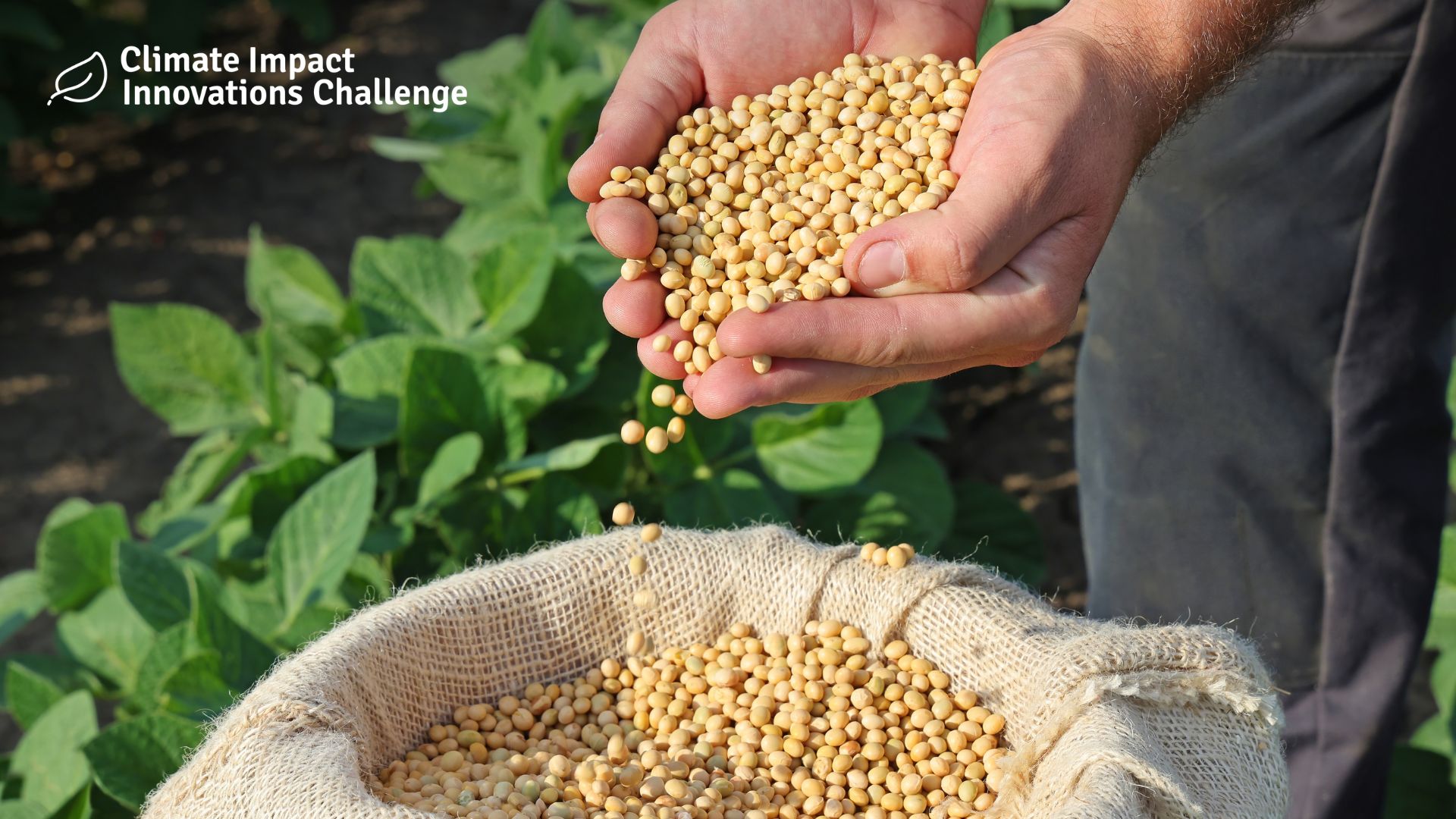
This component focuses on developing food products based on local peanuts (Arachis hypogaea), Indonesian soybeans (Glycine max), and mung beans (Vigna radiata) sourced from the dryland regions of East Nusa Tenggara (NTT) — a region rich in legume biodiversity yet economically marginalised. Local legumes such as cowpeas, local soybeans, peanuts, and mung beans contain relatively complete nutritional compositions, functioning as protein sources with 20–40% protein content on a dry matter basis, alongside essential amino acids, unsaturated fatty acids, dietary fibre, vitamins, and minerals (Naisali et al., 2023).
Product formulations include nutritious snacks, pasta, and ready-to-eat porridge with complete amino acid profiles. Life Cycle Assessment (LCA) studies confirm that legume-based products have significantly lower environmental impact than animal products, with land use of only 2.0–
5.5 m²/kg and far fewer GHG emissions (Lee et al., 2025). This directly addresses both nutritional gaps and the need to decarbonise Indonesia’s food system.
Component 2: Pectin-Based Antimicrobial Edible Coating
The second component utilises an edible coating made from zucchini-derived pectin (5%) with demonstrated antimicrobial properties against Staphylococcus aureus, Escherichia coli, and Aspergillus niger, as well as antioxidant activity of 34.32% at 1 mg/mL. This coating extends tomato shelf life from 9 days to 11 days without affecting physicochemical properties (Jhanani et al., 2024). Edible coatings represent a sustainable, eco-friendly technology that maintains quality and prolongs shelf life — particularly critical for smallholder farmers who lack access to cold storage infrastructure. Adding antimicrobial essential oils to the coating further inhibits microbial growth and extends product viability (Ait Seddik & Amenzou, 2022).
Component 3: Micro Supply Chain Model
A community-scale collection system with simple cold-chain support and a digital quality-tracking platform will increase farmer margins by 20–40% compared to selling raw commodities.
Diversification of local food sources reduces import dependence and strengthens national food resilience (Wijaya & Pratama, 2023).
Alignment with Climate Impact Innovations Challenge 2026
This proposal is explicitly aligned with the mission of the Climate Impact Innovations Challenge 2026 (CIIC 2026), which seeks scalable, evidence-based solutions that directly address climate-related impacts. This innovation fits the Food and Nature Solutions track by:
- Reducing food system emissions through low-carbon local protein alternatives validated by LCA;
- Cutting post-harvest losses with scientifically proven natural preservation technology;
- Strengthening supply chain resilience in climate-vulnerable smallholder communities;
- Offering a replicable model suitable for other tropical developing regions.
By submitting this idea to CIIC 2026, the project will leverage competition support for technical validation, field testing, and access to funding networks and implementation partners. The CIIC platform offers a unique opportunity to transform a well-grounded academic concept into real community impact.
Implementation Strategy
Phase 1 (6 months): Pilot product composition in 2 villages — test protein formulations, natural preservation methods, and consumer preferences; conduct initial LCA and cost analysis.
Phase 2 (12 months): Process optimisation, establishment of simple community processing units, training for farmers and micro-enterprises; monitoring of shelf life and quality parameters.
Phase 3 (12–18 months): Scale-up to neighbouring districts, integration of digital tracking platforms, and preparation of local food safety certification for regional marketing.
Success indicators include: reduction in post-harvest losses (%), reduction in carbon footprint per kg of product, consumer acceptance (% positive sensory tests), and increase in farmer income (%).
Risks and Mitigation
Cultural resistance to innovation will be addressed through hidden protein formulations (encapsulated protein powder) and nutritional education campaigns. Technological limitations at
the village level will be overcome with simple equipment design, technical training, and the use of locally available materials. Early collaboration with local health and food agencies will be sought to accelerate compliance and certification processes.
Conclusion
The combined approach of low-emission local protein substitution and natural preservation technology offers a practical, scalable solution to strengthen food security in the era of climate change. Alternative proteins generally have a lower environmental impact than traditional meat production (Lee et al., 2025). This solution meets the criteria of CIIC 2026 by combining innovation, climate impact relevance, scientific evidence, and scalability potential. Sustainable strategies to achieve national food security must encompass increased agricultural productivity, diversification of local carbohydrate sources, and community empowerment — all of which this proposal directly advances.
Nur Indamala is a runner-up of the Climate Impact Innovations Challenge 2026 Article Competition.