Sustainable Food Innovation: Local Protein Substitution and Natural Preservation for Climate Food Security
July 7, 2026
One Soil Does Not Fit All: Reimagining Soil Restoration for an Unpredictable Climate
July 9, 2026
The Price of Plastic: A Plastic Recovery Certificate Solution for Indonesia's Circular Economy
Written by Jessica Nariko Utomo
Walk through any river in East Java after the rainy season and the water will tell you something economics textbooks rarely admit: the most expensive things in Indonesia are often the ones nobody is paying for.
Plastic is one of them. And it is time the market settled the bill.
A market failure disguised as a waste problem
Indonesia is the world's second-largest contributor to ocean plastic pollution, releasing more than 600,000 tonnes into the sea every year (UNEP; Indonesian Institute of Sciences). Nationally, plastic makes up nearly 20% of all waste generated, roughly 6.8 million tonnes entering the waste stream annually, with 58% of it left uncollected (Ministry of Environment, 2025; SUPRA International, 2025). Four of our rivers: the Brantas, Ciliwung, Citarum, and Progo, rank among the 20 most polluted in the world (Nature Communications, cited in FairPlanet).
These are not merely garbage problems; they are pricing failures.
Plastic is cheap to produce because its price tag never includes what happens after purchase: the cost of collecting it, the damage to marine ecosystems, the health burden of microplastics, or the emissions from open burning — Indonesia's most common waste disposal method, at 3.2 million tonnes per year (NPAP). Economists call this a negative externality. A cost that gets quietly handed to rivers, lungs, and fishing communities while the company that made the bottle walks away clean.
Indonesia’s Extended Producer Responsibility (EPR) framework, guided by the Ministry of Environment Regulation No. 75/2019, the producers are required to submit waste reduction roadmaps targeting a 30% reduction by 2029. But the regulation is voluntary in practice, it neither obliges producers to take specific action nor sets mandatory collection quotas. Between 2020 and 2023, just 27 plastic companies submitted roadmaps, of which only 8 began implementation, collecting a total of slightly over 16,000 tonnes — less than 0.3% of what is generated annually (National Roadmap and Action Plan Circular Economy Indonesia 2025–2045).
The math does not work because the incentives do not work. As long as making plastic remains cheaper than reclaiming it, the market will keep flooding our rivers.
The plastic recovery certificate (PRC) system
We must redesign financial incentives so that recovering plastic is more profitable than abandoning it. The idea I am proposing is a Plastic Recovery Certificate (PRC) system for Indonesia: a regulated market mechanism, modelled on carbon credit trading, that assigns a tradeable value per kilogram of recovered plastic.
Under a mandatory EPR framework with real teeth, plastic producers and importers are assigned annual recovery targets proportional to how much plastic they put on the market. To meet those targets, they can either fund their own collection operations or purchase PRCs on an open exchange. Each certificate represents one kilogram of plastic collected, verified, and channelled into certified recycling. Companies that over-recover can sell surplus certificates. Companies that fall short must buy them. The certificate price floats with market supply and demand, while recovery claims are verified through certified recyclers and registered collection networks.
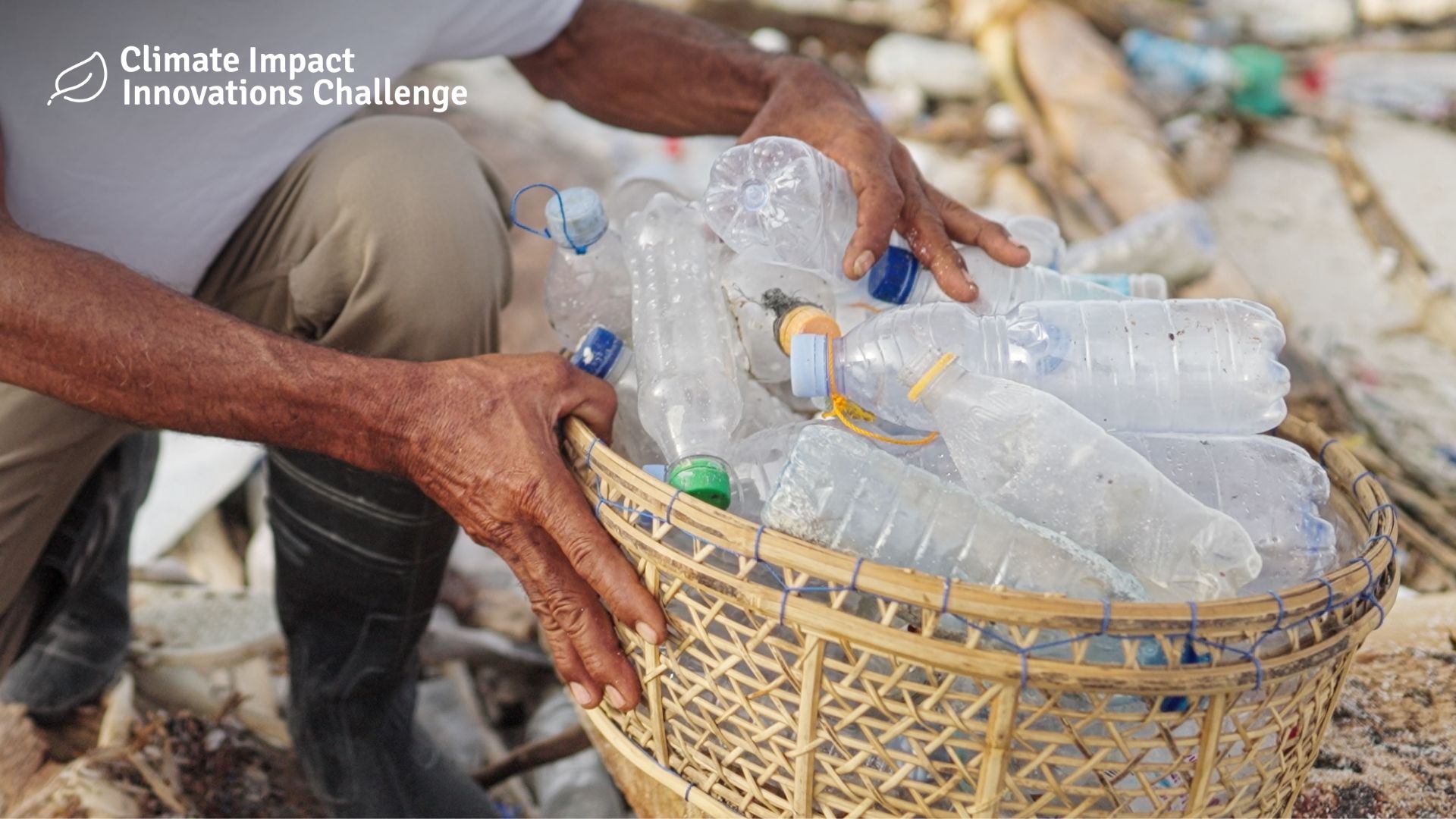
The genius of this mechanism is who benefits. Today, Indonesia's informal waste pickers— the pemulung — collect upwards of 80% of recyclables in some cities, yet operate entirely outside the formal economy with no contracts, no safety nets, and no pricing power (UNDP Indonesia, 2026). Under a PRC system, community waste banks and pemulung cooperatives can generate and sell certificates directly, creating a formal revenue stream for the people doing the most critical environmental work in the country. According to the National Plastic Action Partnership (NPAP), a well-designed EPR system could create up to 150,000 direct jobs in Indonesia's waste and recycling sector alone — and prevent up to 20 million tonnes of CO2 equivalent in emissions per year by keeping plastic out of waterways and away from open burning.
The financing layer reinforces this. Green bonds and sustainability-linked loans can be structured against PRC revenue streams, giving recycling infrastructure developers access to institutional capital. A PRC-backed bond is not a charity instrument, but a debt security with a predictable cash flow, making it attractive to pension funds and institutional investors who need measurable, long-duration returns. Indonesia's own National Circular Economy Roadmap 2025–2045 already identifies plastic packaging as a priority sector — the PRC system gives that roadmap a market engine.
The Climate Impact Innovations Challenge 2026 (CIIC 2026) seeks disruptive innovations that drive sustainability in Indonesia and beyond. The PRC system is not a gadget, but a financial architecture that makes circularity the default economic behaviour.
CIIC 2026's Circular Economy track calls specifically for solutions that promote waste circularity and climate adaptation. A functional plastic credit market addresses both: it reduces the volume of plastic leaking into waterways while building the formal infrastructure and economic resilience that communities need to adapt to climate pressures.
The solution also speaks directly to CIIC's emphasis on scalable, commercially sustainable models. The PRC exchange does not rely on government subsidies to survive — once established, it is self-reinforcing. Higher certificate prices incentivise more collection. More collection supplies more recycled feedstock. More recycled feedstock reduces virgin plastic production. The loop closes, and it closes profitably.
The price of plastic is ours to set
Indonesia does not have a recycling problem. It has a revenue problem, one where the people absorbing the cost of plastic pollution are not the ones who profited from producing it.
A Plastic Recovery Certificate system will not solve everything overnight. But it will do something that awareness campaigns never can: make the economics of waste recovery work for the communities that bear its weight. The pemulung sorting bottles in the heat of a Surabaya afternoon, the waste bank operator in Bandung weighing bags of PET bottles. They are the backbone of a circular economy that has never been properly paid.
If CIIC 2026 is serious about disruptive climate innovation, the most disruptive thing we can do is give the market a price signal it cannot ignore.
Jessica Nariko Utomo is a runner-up of the Climate Impact Innovations Challenge 2026 Article Competition.