Climate Impact Innovations Challenge is back with the largest prize pool of Rp15 billion and a new partner on board
April 8, 2026
SEABLOCK-BIO: The Green Revolution in Restoring Indonesia’s Seagrass Meadows
July 1, 2026

From Coastal Waste to Clean Energy: Reimagining Seashell Waste as Low-Carbon Energy-Generating Infrastructure in Indonesia
Written by Nabilla Aulia
As one of the world's largest maritime nations, Indonesia produces more than 137,000 tons of shellfish annually. However, the economic value extracted from shellfish largely ends after consumption, leaving behind substantial quantities of discarded shells. In coastal processing centers such as Cilincing, North Jakarta, shell waste accumulates at rates reaching 1–4 tons per day. Individual processing businesses can generate up to 20 sacks of shell waste daily, creating a continuous waste stream with limited management options. Much of this material ultimately ends up in landfills, open dumping sites, or coastal waters, contributing to sediment contamination, ecosystem degradation, and potential heavy-metal accumulation in marine environments.
At the same time, Indonesia's rapid infrastructure expansion continues to increase demand for concrete, while cement production contributes approximately 8% of global CO₂ emissions. As road construction accelerates, reducing the environmental footprint of construction materials becomes increasingly important.
Energy dependency adds another layer of complexity. According to the Ministry of Energy and Mineral Resources (KESDM), approximately 85% of Indonesia's electricity generation still relies on fossil fuels. Although renewable energy deployment continues to grow, significant challenges remain in achieving energy diversification while simultaneously meeting increasing electricity demand. The question is no longer whether Indonesia needs cleaner energy and lower carbon infrastructure, but how both objectives can be achieved.
Transforming Waste into Construction Resources
Seashells contain 95–97% calcium carbonate (CaCO₃), which can be converted into calcium oxide (CaO) through calcination. CaO content varies with treatment conditions, ranging from 53.58% at 550°C to 87.21% at 1100°C, highlighting its potential as a supplementary cementitious material, while avoiding the poor bonding and high porosity commonly observed in untreated seashell aggregates (Zhu, et. al., 2024).
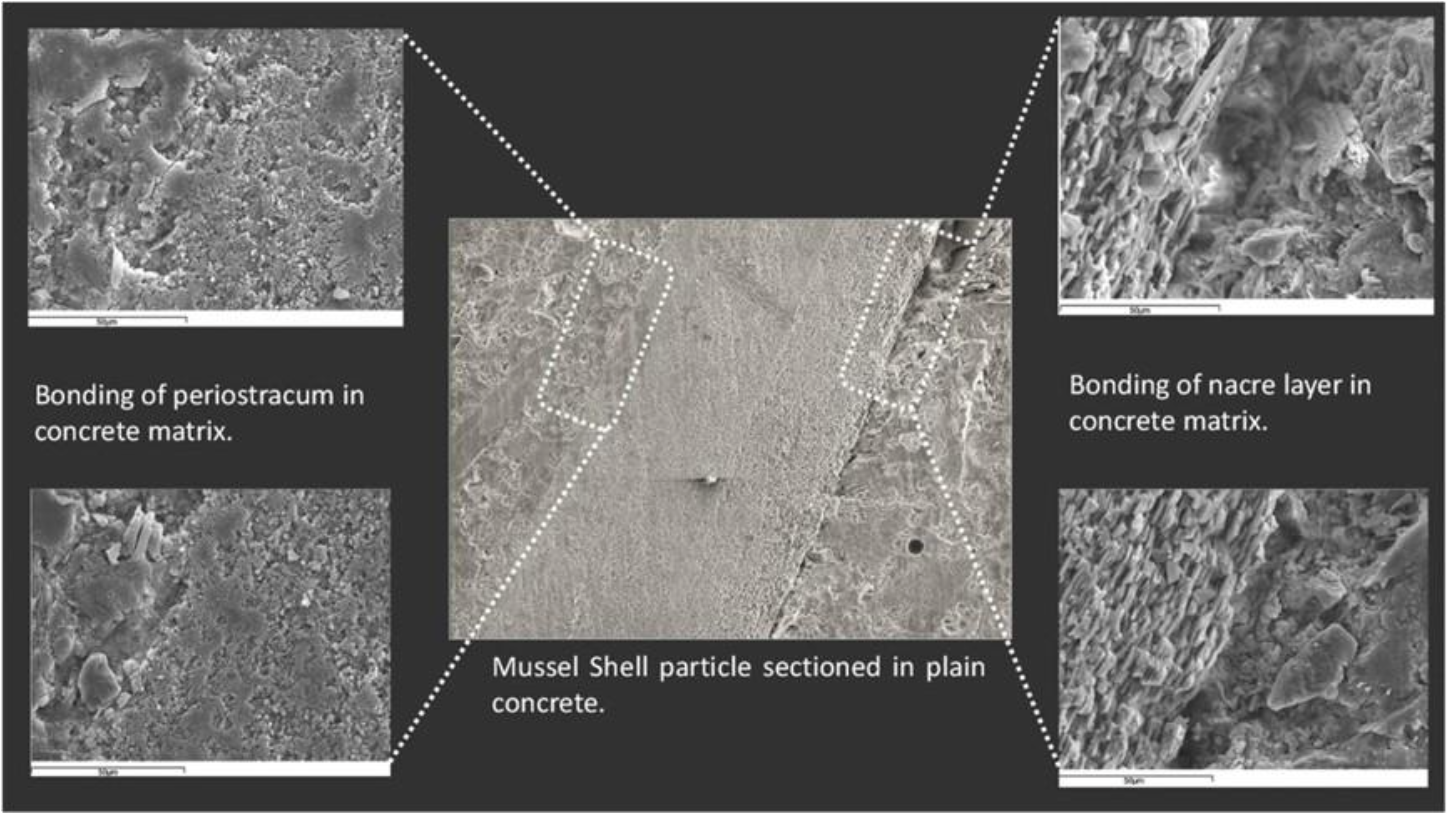
SEM observation of microstructure of seashell concrete.
Several studies have demonstrated that partially replacing Portland cement with processed seashell ash can significantly reduce the environmental impact of concrete production without compromising structural performance. Replacing 10 to 15% of conventional Portland cement with this seashell ash has been shown to reduce CO₂ emissions by up to 36% while maintaining compressive strength comparable to standard concrete mixes targeting 40 MPa. Concrete density decreases slightly from 2,515 to 2,458 kg per cubic meter at 30% replacement, making the pavement lighter without sacrificing structural integrity.
For Indonesia, this creates a circular-economy opportunity by transforming shell waste into a construction resource that reduces both waste generation and cement consumption. The proposed system goes beyond material substitution by integrating energy-harvesting technologies within the pavement structure. Processed seashell ash serves as a low-carbon construction material, while embedded piezoelectric and thermoelectric components enable the roadway to capture both mechanical energy from traffic loads and thermal energy from Indonesia's tropical climate. This integration transforms conventional pavement into multifunctional infrastructure that addresses waste utilization, emission reduction, and renewable energy generation.
Converting Roads into Renewable Energy Assets
Beyond serving as a sustainable construction material, transportation infrastructure can also be redesigned to generate energy. Every vehicle traveling along a road exerts mechanical pressure on the pavement surface. Under conventional conditions, this energy is dissipated as heat, vibration, and structural stress. However, recent advances in piezoelectric technology demonstrate that this otherwise wasted mechanical energy can be harvested and converted into electricity.
Passenger vehicles typically exert approximately 3,750 N of force per wheel, while heavy trucks can impose loads exceeding 50,000 N per axle. Embedded piezoelectric transducers respond to these forces by generating electrical charges proportional to the applied stress. Previous simulations have estimated that a single-lane roadway carrying around 500 vehicles per hour can generate approximately 255 kWh of electricity per kilometer per day. Annual energy production under average traffic conditions has been estimated at roughly 44000 kWh per kilometer (Najini & Muthukumaraswamy, 2017).
The feasibility of piezoelectric road technology has been validated through pilot projects in Israel. A 10-meter road section equipped with embedded piezoelectric devices at the Hefer Intersection generated approximately 2 kWh of electricity under real traffic conditions, sufficient to operate roadside LED lighting (Eltayeb et al., 2016). Similarly, Moure et al. (2023) reported that a 16-cantilever piezoelectric system exposed to around 1500 vehicles per day produced enough electricity to continuously illuminate a 200-meter LED lane marking system. Considering that traffic volumes on major Indonesian urban corridors often exceed 10000 vehicles daily, the electricity generation potential could be significantly greater than those demonstrated in existing pilot applications.
While piezoelectric devices harvest energy from vehicle movement, road surfaces also store substantial thermal energy. Indonesia's high pavement temperatures make thermoelectric technology a complementary solution for maximizing energy recovery from the same infrastructure.
Harvesting Energy from Indonesia's Tropical Climate
Indonesia's climate provides another overlooked source of renewable energy. Road surfaces exposed to tropical sunlight frequently reach temperatures between 50°C and 60°C during daytime hours, while subsurface soil temperatures remain relatively stable at approximately 25–28°C. This naturally occurring temperature difference creates favorable conditions for thermoelectric power generation.
Thermoelectric generators (TEGs) convert temperature gradients directly into electricity through the Seebeck effect. Studies indicate that TEG-integrated concrete infrastructure can produce between 0,5-2 W/m² under optimal operating conditions. For a one-kilometer roadway with a lane width of three meters, this translates to an annual electricity generation potential ranging from approximately 5,400 to 21,600 kWh .
When combined with piezoelectric harvesting systems, total electricity generation could reach approximately 49,400–65,600 kWh per kilometer per year. Such output would be sufficient to support street lighting networks, traffic monitoring systems, environmental sensors, and public facilities located along transportation corridors.
From Coastal Waste to National Impact
This integrated approach aligns closely with the vision of the Climate Impact Innovations Challenge (CIIC) 2026, Indonesia's largest climate innovation competition. Through a total pilot funding pool of Rp15 billion, CIIC supports scalable solutions capable of addressing ecological challenges while delivering measurable climate impact. Pilot deployment could begin in Surabaya, Makassar, and North Jakarta, where shell waste availability and infrastructure development converge. With shellfish production continuing to grow and infrastructure investment accelerating toward Indonesia Vision 2045, the opportunity to transform coastal waste into low-carbon, energy-generating infrastructure is both technically feasible and strategically timely.
Nabilla Aulia is the Energy Transition Track winner of the Climate Impact Innovations Challenge 2026 Article Competition.